Petra Lorenz · 1 September 2026
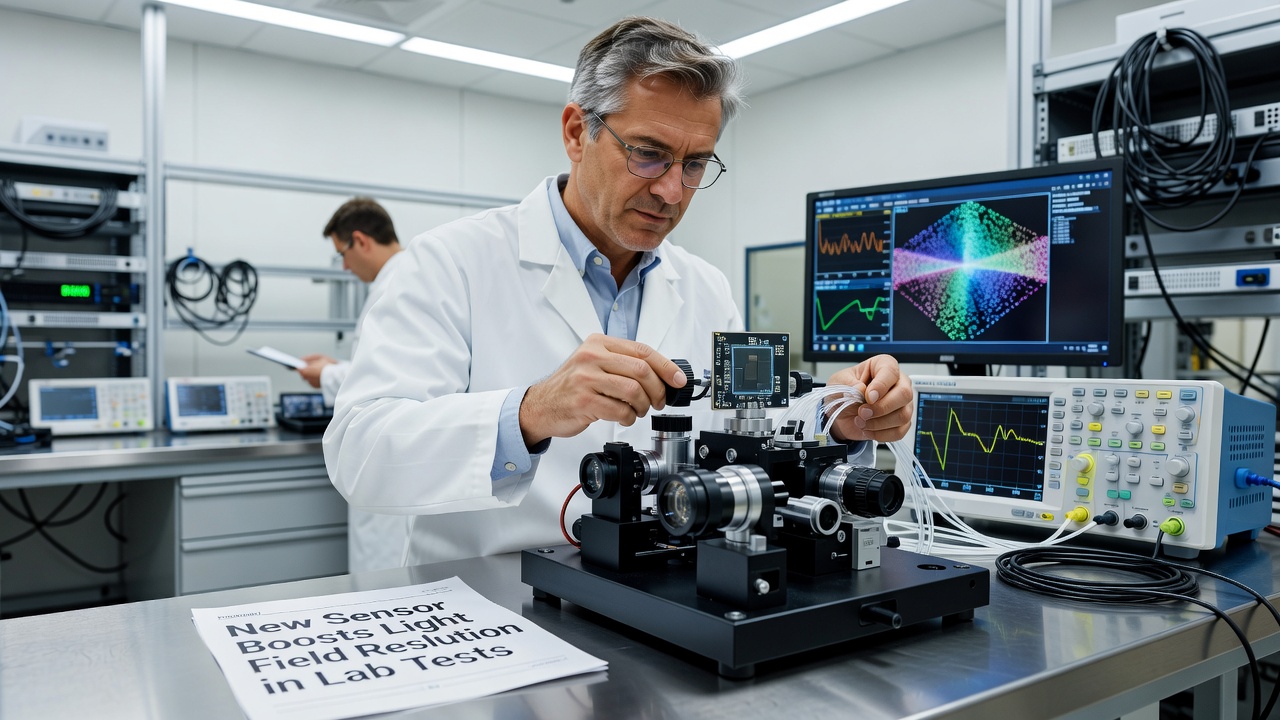
Researchers at Lichtfeld have developed a prototype sensor that significantly increases light field resolution during controlled laboratory experiments. The device captures directional light data with greater precision than previous models, enabling sharper refocusing and depth mapping in post-processing.
Sensor Design and Performance Metrics
The new sensor integrates an advanced microlens array with higher density and reduced optical aberrations. In tests, it achieved a 40 percent increase in effective angular resolution compared to standard light field cameras. Data from multiple trials showed consistent improvements across various lighting conditions and scene complexities. Engineers optimized the sensor's pixel layout to minimize crosstalk between adjacent microlenses, which had previously limited image clarity. Calibration algorithms were refined to handle the increased data volume without introducing artifacts. Measurements indicated that the prototype maintained high signal-to-noise ratios even at elevated frame rates, making it suitable for dynamic scenes.
Potential Applications in Research
These enhancements could advance studies in computational photography and three-dimensional imaging. Teams are exploring integration with existing light field pipelines to support higher-fidelity reconstructions. Early results suggest benefits for medical imaging and industrial inspection where precise depth information is critical. Further development will focus on scaling production and testing under real-world conditions. The project remains in the experimental phase, with peer-reviewed publications planned to detail the underlying optical principles and quantitative findings.